Buyers Guide to Medical Billing Software for Billing Companies: Specialty Healthcare Edition

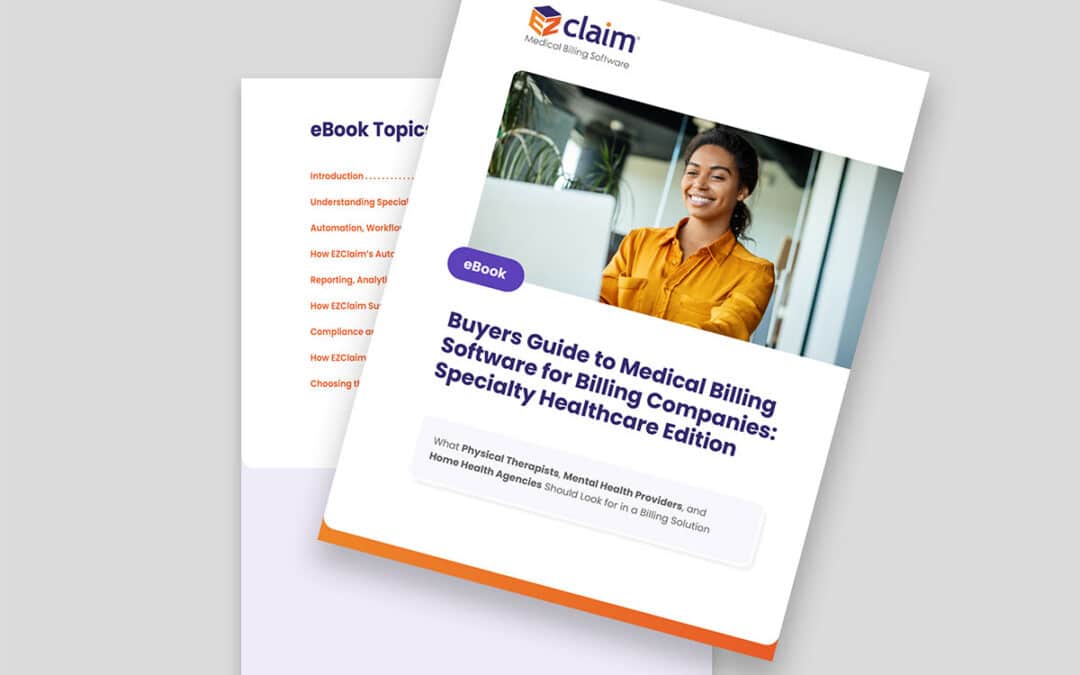
Buyers Guide to Medical Billing Software for Billing Companies: Specialty Healthcare Edition

Download Now

Physical therapy practices, mental health providers, and home health agencies often have billing requirements that extend beyond standard billing workflows. Documentation requirements, authorizations, payer rules, and reimbursement processes can all influence which solution is the right fit.

This buyer’s guide explores the capabilities that matter most when evaluating medical billing software for billing companies and specialty healthcare organizations. Whether you’re comparing platforms like EZClaim or reviewing your current system, you’ll get a closer look at the tools and functionality that can support specialty healthcare billing.

What to Look For in Medical Billing Software for Billing Companies

Physical therapy practices, mental health providers, and home health agencies often face billing requirements that can make software selection more complicated. This guide breaks down the features, functionality, and considerations that can help when comparing billing solutions.

What’s inside:

  • The unique billing challenges specialty healthcare organizations often face
  • Claims management and workflow tools that can help support reimbursement processes
  • Reporting and analytics capabilities that help you better understand billing performance
  • Revenue cycle tools that provide greater insight into billing activity
  • Compliance and data security features to consider when comparing solutions

Frequently Asked Questions

K
L
What is the best medical billing software for billing companies that support specialized healthcare practices?
The best medical billing software helps billing companies manage claims efficiently while supporting the needs of different specialties. EZClaim offers flexible tools that help streamline billing workflows, improve visibility, and support a variety of healthcare organizations.
K
L
Why do specialty healthcare organizations have different billing software needs?
Specialty healthcare organizations often deal with unique documentation requirements, payer rules, and billing processes. Software that can support those workflows can help reduce administrative work and improve claim accuracy.
K
L
How does EZClaim support physical therapy, mental health, and home health care practices?
EZClaim provides billing tools that can be adapted to different specialty workflows. From electronic claims submission to reporting and claim management, the platform helps organizations handle billing tasks more efficiently and stay organized as they grow.

Healthcare Claims Management Software for Independent Practices

Healthcare Claims Management Software for Independent Practices

Download Now

Claim denials and delayed reimbursements can slow down the revenue cycle faster than most practices expect.

As billing issues and follow-up work build up, it becomes harder to keep claims moving and stay on top of collections.

That is why more practices are focusing on improving visibility and consistency across the billing process.

This guide explores practical strategies for getting more value from healthcare claims management software, reducing denials, accelerating collections, and improving revenue cycle performance over time.

Reduce Claim Denials and Improve Cash Flow with Smarter RCM Strategies

Discover practical, real-world strategies designed to help independent practices improve billing performance, strengthen collections, and keep the revenue cycle moving more consistently.

What’s inside:

  • A breakdown of the revenue cycle from intake to reimbursement
  • Common causes of claim denials—and how to prevent them
  • Strategies to improve clean claim rates 
  • Best practices for accelerating collections and improving cash flow
  • Key features to look for when choosing the right RCM software

Frequently Asked Questions

K
L
What are the most common causes of claim denials in independent practices?
Some of the most common causes include coding errors, eligibility issues, missing patient information, and incomplete claims. Many denials are tied to workflow gaps that were not identified before submission.
K
L
How can independent practices improve their clean claim rate?
Improving clean claim rates starts with stronger front-end and billing workflows. Eligibility verification, claim scrubbing, standardized coding practices, and consistent follow-up all help reduce errors before claims are submitted.
K
L
What should I look for in revenue cycle management software for independent practices?
Look for software that helps simplify billing workflows, improve claim visibility, reduce manual work, and support more consistent reimbursement activity. Features like claim tracking, reporting, automation, and integration support also play an important role.

Medical Billing Systems Evaluation Guide for Independent Practices and Billing Companies

Medical Billing Systems Evaluation Guide for Independent Practices and Billing Companies

Most teams do not struggle to find medical billing systems. They struggle to compare them in a way that reflects how billing works.

On the surface, many platforms look similar. In practice, the differences show up in:

  • How tasks move from one step to the next
  • How easy it is to stay organized
  • How well the system holds up as your workload increases

This guide gives you a clearer way to evaluate medical billing system software by focusing on what matters in day-to-day billing and how your workflow holds up over time. It reflects the same focus on consistent, connected processes that EZClaim’s medical billing software is built to support as your operation grows.

A Smarter Way to Evaluate a Medical Billing System

It’s easy to get pulled into feature lists, but more features don’t always mean a better fit. What matters is how the system supports your day-to-day billing and whether it can keep up over time. 

A more practical way to evaluate is to focus on core capabilities, how the system fits into your workflow, and whether it can support you as your needs grow.

This guide gives you a more structured way to compare options and make a decision based on what your billing process requires.

What’s inside:

  • How to Evaluate Core Billing Capabilities, day-to-day usage, and scalability
  • How to Identify Workflow Inefficiencies
  • How EZClaim supports independent practices and small businesses

Frequently Asked Questions

K
L
What is the best way to evaluate medical billing systems?
The best approach is to look beyond features and focus on how the system supports your day-to-day billing. Pay attention to core capabilities, how easily your team can use it, and whether it fits into your workflow without adding extra steps.
K
L
What should small practices look for in medical billing system software?
Focus on what will make your day easier. A good system should be simple to use, cover the basics well, and help you stay on top of billing without creating more work for your team.
K
L
How do I know if a medical billing system will scale with my organization?
Think about whether the system can grow without forcing you to change how you work. It should be able to handle more volume and give you better visibility as you grow, without slowing things down.

Download Now

Scaling Operations with  Medical Billing Claims Software

Scaling Operations with Medical Billing Claims Software

As medical billing companies grow, the work behind the scenes grows with them. More clients mean more claims to process, more reporting to manage, and more billing activity moving through your system every day.

Without the right tools, keeping everything organized can become challenging. Billing companies often run into issues like:

  • Managing claim activity across multiple provider clients
  • Keeping up with increasing claim volumes
    Maintaining consistent billing workflows across accounts
  • Staying on top of billing performance and reporting

Solutions like EZClaim help billing companies bring provider accounts, claims, and reporting together in one system so teams can manage billing operations more clearly as their client base expands.

Scale Multi-Client Billing Operations with EZClaim’s Medical Billing Claims Software

Expanding a billing company requires more than simply handling additional claims. It also means building workflows and systems that allow teams to manage multiple provider accounts while keeping billing activity organized and easy to review.
This guide outlines practical strategies billing companies can use to structure their operations for growth using medical billing claims software.

What’s Inside

  • How to build a scalable billing infrastructure within EZClaim to support growing provider portfolios
  • How to manage increasing claim volumes across multiple providers using EZClaim’s medical billing claims software
  • How to use EZClaim’s reporting tools to maintain visibility across expanding billing operations

Frequently Asked Questions

K
L
Why is scaling operations difficult for billing companies?
As billing companies add more clients, claim volume, payer requirements, and reporting demands increase quickly. Without structured systems, it becomes harder to keep claims organized and maintain visibility across multiple client accounts.
K
L
How can billing companies prepare their operations for growth?
Billing companies can prepare for growth by using systems that keep provider accounts, claim workflows, and reporting organized as the client base expands. A centralized billing platform helps teams manage higher claim volumes while maintaining consistent processes.
K
L
What role does medical billing claims software play in scaling billing operations?
Medical billing claims software helps billing companies manage claims, provider records, and reporting within one system. This allows teams to support more providers and higher claim volumes while maintaining clear oversight of billing activity.

Download Now

A Guide to Using Healthcare Billing Systems for Workflow Optimization

A Guide to Using Healthcare Billing Systems for Workflow Optimization

Billing workflows don’t usually break all at once. They get heavier over time. A few manual steps here, a workaround there, and suddenly billing takes longer than it should. This makes a difference for your staff and for your cash flow.

Getting things back on track starts with how work moves through the revenue cycle. When workflows are clear and routine tasks are handled automatically, teams spend less time fixing issues and more time doing the work that actually moves claims forward. That is where healthcare billing systems come in.

EZClaim’s medical billing software helps bring billing work into one place, reduces manual effort, and makes it easier to see what is happening at each step. This guide walks through how healthcare billing systems can help simplify billing and make day-to-day work easier to manage.

Improve RCM Efficiency with EZClaim’s Healthcare Billing Systems

Improving revenue cycle efficiency is not about doing everything at once. It starts with tightening workflows, reducing manual effort, and making it easier to see where work gets stuck.

This guide is designed to help you evaluate how your workflows are structured and where changes will have the greatest impact. It focuses on how healthcare billing systems support consistency, reduce manual effort, and help billing teams stay effective as volume and complexity change.

What’s inside:

  • A workflow optimization framework centered on standardization and automation
  • Step-by-step guidance for tightening RCM workflows and reducing inefficiencies
  • How healthcare billing systems help teams improve consistency and control
  • Insight into building billing operations that scale without adding strain

Put this framework to work.

Frequently Asked Questions

K
L
Why is workflow optimization critical to high-performing RCM teams?

Optimized workflows reduce errors, rework, and delays by giving billing teams a clear way to manage their work. This helps teams stay organized and efficient as volume and complexity increase.

K
L
How can organizations improve efficiency without adding billing staff?

Efficiency improves when teams standardize their workflows and automate routine tasks. This allows staff to handle more work without increasing daily workload or burnout.

K
L
What role do healthcare billing systems play in workflow optimization?

Healthcare billing systems centralize billing activity and support consistent workflows across the revenue cycle. They provide the visibility needed to identify issues early and keep billing work moving efficiently.

Download Now

The Clean Claims Blueprint: Reducing Denials With an Advanced Claim Processing System

The Clean Claims Blueprint: Reducing Denials With an Advanced Claim Processing System

Most claim denials are preventable. Many start long before a claim is ever submitted, when inconsistent claim creation, manual checks, and limited visibility allow small issues to pass through unnoticed.

A modern claim processing system helps address this by standardizing how claims are built, validating information earlier, and flagging problems before they reach the payer. 

In this eBook, you’ll see how EZClaim applies those capabilities to help you catch issues earlier and submit cleaner claims.

Discover How to Reduce Denials with EZClaim’s  Advanced Claim Processing System

This eBook focuses on how denial reduction works when it is treated as a system-level process. You’ll see how a modern claim processing system supports more consistent execution by bringing structure to claim creation, applying validation earlier, and reinforcing repeatable workflows across teams and organizations. 

What’s inside:

  • A systems-based approach to reducing claim denials before submission
  • Practical steps to standardize and automate claim workflows
  • How a modern claim processing system helps catch errors earlier
  • Ways to maintain consistency across teams, locations, and clients
  • Guidance for reducing rework and improving revenue predictability

Stop managing denials after the fact.

Frequently Asked Questions

K
L
What are the most common causes of claim denials today?
Claim denials are often driven by inconsistent data entry, missing or incorrect information, and a lack of standardized workflows, issues that can be mitigated with a structured claim processing system.
K
L
How can practices reduce claim denials without adding staff?
Practices can reduce denials by standardizing how claims are created and reviewed and by validating information earlier in the process. This shifts work upstream and reduces reliance on manual review.
K
L
Why is a claim processing system critical for denial reduction at scale?
A claim processing system like EZClaim enforces consistency, automates error detection, and provides visibility into claim performance, enabling denial reduction to be repeatable and sustainable.

Download Now